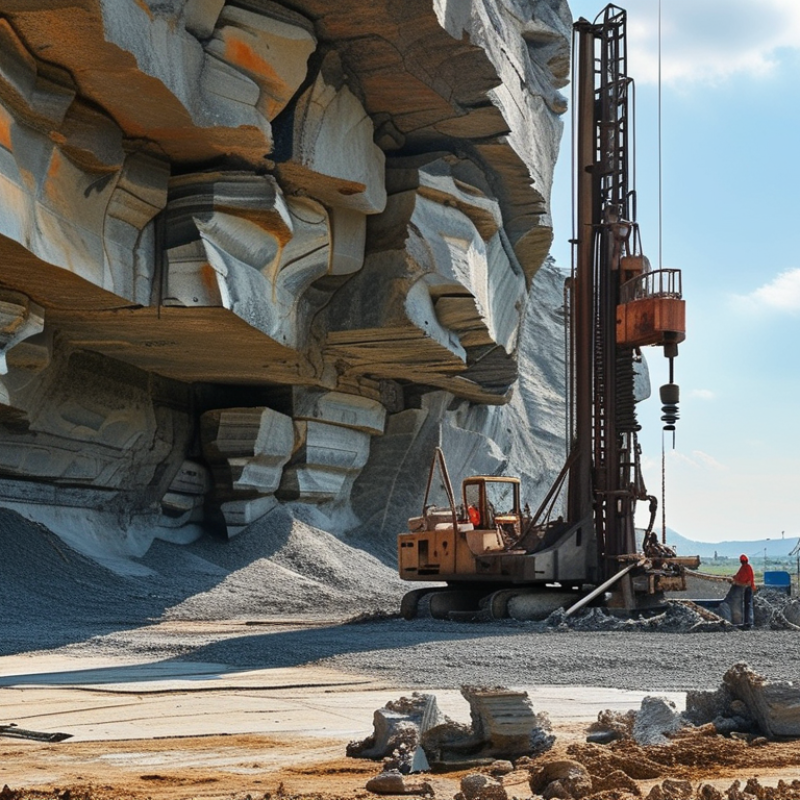
Top 10 Ways Formation Hardness Affects Drilling Speed

Time:2026-09-11 Author:Oliver
0%

Drilling speed is rarely controlled by the rig alone. The rock beneath the bit sets a demanding boundary. Soft shale may yield quickly, while dense granite can resist every rotation. This difference changes the rate of penetration, bit wear, torque, vibration, and energy consumption.

So, how does formation hardness affect drilling speed? Hard formations usually require greater weight on bit and carefully controlled rotary speed. Excessive force can crush cutters, overheat bearings, or create damaging vibrations. Insufficient force may cause the bit to polish the rock instead of breaking it. On the rig floor, these changes appear as slower penetration, rising torque, unstable pressure, and smaller cuttings. Even a few meters of stronger rock can alter an entire drilling schedule.

This guide examines ten practical ways formation hardness influences drilling performance. It connects unconfined compressive strength, abrasiveness, rock texture, and bit selection with measurable field results. Experienced drilling teams compare drilling records, mud returns, vibration data, and real-time MWD information before changing parameters. That evidence matters more than assumptions based only on a geological description.

Hardness is not the whole story. Fractures, pore pressure, temperature, and hydraulics can also change performance. Field measurements are sometimes incomplete, and operators may misread a sudden slowdown. A careful review remains necessary. The following points provide a reliable framework for improving drilling speed without sacrificing equipment life, hole quality, or operational control.

Top 10 Ways Formation Hardness Affects Drilling Speed

Define UCS: 5–25 MPa soft, 25–75 MPa medium, >75 MPa hard

Formation hardness directly controls drilling speed through ten linked effects: bit penetration, thrust, torque, rotation, vibration, heat, wear, dust, cuttings removal, and achievable meterage. Use unconfined compressive strength (UCS) as the first screening value. In this guide, 5–25 MPa indicates soft rock, 25–75 MPa indicates medium rock, and above 75 MPa indicates hard rock.

Soft formations usually allow fast penetration, but weak walls can collapse around the hole. Medium rock needs balanced thrust and rotation; excessive force may create vibration instead of useful cutting. Hard rock demands more energy, produces slower penetration, and accelerates cutter wear. The International Society for Rock Mechanics and Rock Engineering recommends UCS testing for consistent rock characterization. U.S. Army Corps of Engineers EM 1110-2-2901 also links rock strength, fractures, and drilling behavior. These reports warn against treating UCS as the only field variable. Moisture, bedding, and abrasive minerals can change results sharply. A 60 MPa intact sample may drill differently from fractured rock at the same strength. That distinction is often missed.

Tips: Record UCS beside penetration rate, torque, thrust, and vibration. Compare readings every 5–10 metres. Reduce thrust when torque rises without faster penetration. Check cuttings for angular chips and excessive fines. Hardness bands are useful, not perfect. Field judgment still matters.

Top 10 Ways Formation Hardness Affects Drilling Speed

Unconfined Compressive Strength (UCS) is commonly used to classify formation hardness: 5–25 MPa = soft, 25–75 MPa = medium, and >75 MPa = hard. The chart uses a normalized drilling-speed index, where 100 represents drilling in a 5 MPa formation. As UCS increases, rock crushing, bit wear, vibration, and energy demand generally reduce penetration rate.

The index is an engineering comparison rather than a universal field measurement. Actual drilling speed also depends on bit design, rotary speed, weight on bit, hydraulic conditions, abrasivity, fracture intensity, and operating practices.

Compare ROP: 10–30 m/h in soft rock versus 1–5 m/h in hard rock

Top 10 Ways Formation Hardness Affects Drilling Speed

Compare ROP: 10–30 m/h in soft rock versus 1–5 m/h in hard rock

Formation hardness directly changes the rate of penetration, or ROP. In soft shale, clay, or weathered sandstone, drilling may reach 10–30 m/h. The bit cuts easily, and less energy is lost. Hard granite, dense limestone, or strong volcanic rock may reduce ROP to 1–5 m/h. Cutting teeth face greater resistance. Vibration and heat also increase.

Hardness affects more than cutting speed. It influences weight on bit, rotary speed, hydraulic cleaning, and bit wear. Excessive weight can crush the cutting structure or create damaging vibration. Low weight may polish the rock instead of breaking it. Rock abrasiveness matters too. Two formations can show similar hardness but produce different drilling results. A neat chart can mislead. Field measurements still matter.

Tips: Track ROP every meter, not only per stand. Compare drilling speed with torque, pressure, vibration, and cuttings shape. If ROP falls suddenly, check for a harder layer, worn cutters, poor hole cleaning, or unstable operating settings. Small adjustments often help. Do not chase speed blindly. A faster run may increase wear, deviation, or unplanned trips. Review the data after each section, and question assumptions that no longer fit the formation.

Adjust WOB and RPM within API/IADC bit limits as torque increases

Top 10 Ways Formation Hardness Affects Drilling Speed

Formation hardness changes how efficiently a bit converts surface energy into rock removal. Soft shale may accept higher WOB, while hard limestone can create damaging torque spikes. Torque climbs fast. I monitor torque, RPM, WOB, standpipe pressure, and rate of penetration together. A faster penetration rate is not always better if vibration or bit wear increases.

When torque rises, reduce WOB in small steps before making aggressive RPM changes. Excessive WOB can overload cutters and cause stick-slip in hard intervals. Lowering RPM may reduce torsional vibration, but it can also limit cutting speed. The correct response depends on lithology, bit design, hydraulics, and the current drilling signature. Adjust both WOB and RPM only within documented API/IADC guidance and the bit’s approved operating limits.

Field crews should make one controlled change, then watch several minutes of stable data. Small changes matter. I have seen operators chase a falling penetration rate by adding WOB, only to worsen torque and damage the bit. That approach needs reconsideration. A better practice is to compare torque response, vibration, cuttings condition, and energy use after each adjustment. Harder rock may require slower, steadier drilling rather than maximum surface parameters. If torque remains unstable, pause, confirm the downhole condition, and review the operating window before continuing.

Control abrasivity: quartz-rich rock may reduce PDC bit life by 30–70%

Top 10 Ways Formation Hardness Affects Drilling Speed

Formation abrasivity can control drilling speed more sharply than compressive strength alone. Quartz-rich rock may reduce PDC bit life by 30–70%, especially when cutting edges face constant abrasive contact. The result is often gradual, not dramatic. ROP slips, torque rises, and the dull cutters generate more heat. Small changes matter.

Experienced drilling teams watch torque, vibration, flow, and cuttings together. A sudden torque increase can indicate cutter wear or unstable rock interaction. Reducing weight on bit may protect the cutters, but excessive reduction can waste drilling time. Adjusting rotary speed and hydraulic cleaning requires measured field trials. There is no universal setting.

Hard abrasive intervals often produce angular, sand-like cuttings. These particles can scour cutters and accelerate wear across the bit face. Bit records, caliper data, and dull-condition photographs help confirm the mechanism. Rock testing can improve planning, yet laboratory abrasivity values do not perfectly predict every well. That limitation deserves attention. Bedding, natural fractures, fluid properties, and poor hole cleaning may change the outcome.

A practical response includes shorter inspection intervals and conservative operating changes. Monitor penetration trends every few meters, not only at the connection. If ROP falls while torque climbs, continuing unchanged may damage the bit quickly. The better decision may be slower drilling for a short interval. Sometimes, that saves the run.

Top 10 Ways Formation Hardness Affects Drilling Speed – Control Abrasivity: Quartz-Rich Rock May Reduce PDC Bit Life by 30–70%

Engineering reference ranges for planning drilling performance in hard and abrasive formations

No. Formation Property Representative Range Effect on Drilling Speed Typical PDC Bit Impact Practical Control Measure
1 Unconfined Compressive Strength (UCS) 20–50 MPa: soft to medium
50–100 MPa: hard
>100 MPa: very hard
Compared with a 20–50 MPa baseline, ROP commonly falls by approximately 10–25% at 50–100 MPa and 25–60% above 100 MPa, depending on bit design and operating parameters. Higher torque, cutter impact loading, and greater risk of cutter damage. Use adequate weight on bit, maintain stable RPM, and select cutters designed for high-impact loading.
2 Mineral Hardness Mohs hardness: 3–4 for many carbonates; 6–7 for quartz-rich rocks Harder minerals resist shearing and may reduce achievable ROP by roughly 15–40% under comparable hydraulic and mechanical conditions. Higher cutter wear and more frequent loss of cutter sharpness. Optimize cutter exposure, use appropriate back rake, and avoid excessive RPM that accelerates thermal wear.
3 Quartz Content <20 vol.%: low
20–40 vol.%: moderate
>40 vol.%: high
Quartz-rich intervals can lower ROP by approximately 15–45% relative to less abrasive sections, particularly when the rock is also strong and well cemented. PDC bit life may be reduced by approximately 30–70% in highly abrasive quartz-rich intervals; the actual reduction depends on quartz grain size, distribution, and operating conditions. Monitor torque and ROP trends, use abrasion-resistant cutters, control RPM, and plan timely bit changes before severe wear develops.
4 Cerchar Abrasivity Index (CAI) 0–0.5: low
0.5–1.0: moderate
1.0–2.0: high
>2.0: very high
High CAI formations can produce a progressive ROP decline as cutters wear, often requiring a reduction in RPM or an increase in controlled WOB. Accelerated cutter abrasion, increased torque fluctuation, and shorter effective bit runs. Use laboratory abrasivity data in bit selection and establish an MSE, torque, and ROP surveillance limit.
5 Brittleness and Tensile Strength Low brittleness: ductile response
High brittleness: efficient chip formation but greater impact potential
Brittle rock may drill quickly when properly engaged, but fractured or irregular intervals can reduce effective ROP by approximately 10–30% through inefficient cutter engagement and vibration. Higher risk of chipping, impact damage, and cutter delamination in unstable rock. Use vibration-resistant designs, smooth parameter changes, and controlled WOB to limit shock loading.
6 Chert, Flint, or Siliceous Nodules Intermittent hard bands or nodules within a softer matrix Short hard inclusions can cause instantaneous ROP drops of approximately 20–60% and may trigger stick-slip or bit bounce. Localized cutter breakage and uneven wear across the bit face. Reduce sudden WOB changes, improve bottomhole cleaning, and select a bit with balanced cutter distribution.
7 Grain Size and Grain Bonding Fine-grained, tightly cemented versus coarse-grained, weakly bonded rock Tightly bonded grains require more energy to fracture and can reduce ROP by approximately 10–35% compared with weakly bonded material of similar UCS. Fine abrasive grains may cause rapid uniform cutter wear; coarse grains may cause impact loading when they break out. Match cutter geometry to the dominant failure mode and maintain effective hydraulic cleaning at the bit face.
8 Bedding, Foliation, and Fracture Orientation Weak planes parallel, oblique, or perpendicular to the wellbore Weak planes may improve initial breakage but can cause vibration, under-gauge wear, and hole instability, producing an effective ROP loss of approximately 5–25%. Uneven cutter loading and accelerated gauge-pad or shoulder wear. Use real-time vibration monitoring, adjust RPM and WOB gradually, and maintain adequate circulation for cuttings removal.
9 Hard–Soft Interbedding Alternating layers with large contrasts in UCS or abrasivity Frequent changes in formation strength can reduce average ROP by approximately 10–30% because parameters must be kept within a safe compromise window. High risk of cutter impact, bit whirl, and uneven wear between hard and soft sections. Use formation-specific parameter schedules, stabilize the BHA, and avoid aggressive settings across transition zones.
10 Effective Stress and Compaction Increasing confining stress with depth and reduced pore volume Higher effective stress suppresses crack growth and may reduce ROP by approximately 10–35% compared with the same rock at lower confinement. Greater torque demand, more thermal loading, and increased sensitivity to poor hydraulics. Optimize hydraulic horsepower, maintain suitable differential pressure, and use controlled WOB/RPM combinations.
Engineering note: The percentages shown are indicative planning ranges rather than universal constants. Actual drilling speed and bit life depend on lithology, depth, confining stress, bit design, WOB, RPM, hydraulics, vibration, well trajectory, and formation variability. Quartz-related PDC life reduction of 30–70% is most applicable to highly abrasive, quartz-rich intervals under otherwise comparable drilling conditions.

Manage vibration and hydraulics as hard formations increase heat and stick-slip

Top 10 Ways Formation Hardness Affects Drilling Speed

Manage vibration and hydraulics as hard formations increase heat and stick-slip

Hard formations resist bit penetration and convert more energy into heat. That heat can damage cutting structures, weaken seals, and reduce drilling efficiency. Field teams should watch torque, weight on bit, rotary speed, and return temperature together. A single reading rarely explains the entire problem.

Vibration often appears as irregular torque, rising acceleration, or repeated pressure pulses. These signals may indicate poor weight control or an unsuitable rotary speed. Small adjustments can help stabilize the bit. Reduce weight gradually, then change rotary speed in controlled steps. Avoid sudden corrections. They can intensify stick-slip.

Hydraulics also become critical in abrasive rock. Higher flow may improve cuttings transport, but excessive pressure can overload the system. Check nozzle condition, flow rate, standpipe pressure, and the cleanliness of returns. Hot, muddy returns deserve immediate attention. Cuttings should reach the surface without repeatedly falling back around the bit. In practice, the best setting is rarely obvious. Hardness varies within the same interval, and yesterday’s successful parameters may fail today. I would record every adjustment, including the ones that did not work. That imperfect record often reveals the safest drilling window. Crew communication matters, especially when vibration increases faster than penetration. A slower rate may protect the hole and save time later.

FAQS

: How does formation hardness affect drilling speed?

: Soft shale may accept higher weight on bit. Hard limestone can create sharp torque spikes. Faster penetration is not always better.

What should crews monitor while drilling hard rock?

Track torque, rotary speed, weight on bit, pressure, vibration, and penetration rate. Check them together. One reading can mislead you.

What should happen when torque suddenly increases?

Reduce weight on bit in small steps. Avoid aggressive rotary-speed changes immediately. Then observe stable data for several minutes.

Can lowering rotary speed solve torque problems?

It may reduce torsional vibration. However, it can also reduce cutting speed. The response depends on the rock and bit design.

How does abrasive rock damage cutting edges?

Quartz-rich rock can shorten cutting-edge life by roughly 30–70 percent. Angular, sand-like cuttings may scour the bit face. Heat and torque can rise gradually.

What does falling penetration with rising torque suggest?

It may indicate cutter wear, poor cleaning, or unstable rock contact. Continuing unchanged may damage the bit quickly. That assumption still needs field confirmation.

How can crews adjust drilling parameters safely?

Make one controlled change at a time. Stay within documented operating limits and approved bit limits. Compare torque, vibration, cuttings, and energy use afterward.

How often should drilling performance be reviewed?

Check penetration trends every few meters. Do not wait only for each connection. Shorter inspection intervals help in abrasive intervals.

What should crews do if torque remains unstable?

Pause drilling and confirm the downhole condition. Review the operating window before continuing. Sometimes slower drilling saves the run. Sometimes, the diagnosis is wrong.

Conclusion

Formation hardness is a major factor in drilling performance because it determines how efficiently the bit can break and remove rock. A practical measure is unconfined compressive strength (UCS): soft formations typically range from 5–25 MPa, medium formations from 25–75 MPa, and hard formations exceed 75 MPa. This difference can reduce the rate of penetration from approximately 10–30 m/h in soft rock to only 1–5 m/h in hard rock. Understanding how does formation hardness affect drilling speed helps engineers select safer and more effective operating parameters.

As hardness increases, weight on bit and rotary speed should be adjusted carefully within the bit’s API and IADC operating limits, especially as torque rises. Hard formations may also be more abrasive; quartz-rich rock can shorten cutting-structure life by roughly 30–70%. In addition, stronger rock often generates more heat, vibration, and stick-slip, making hydraulic control and vibration management essential for maintaining stable drilling, protecting equipment, and achieving consistent penetration.

Oliver

Oliver

Oliver is a seasoned marketing professional with a wealth of expertise in driving brand awareness and engagement. With a deep understanding of our company's product offerings, he consistently delivers high-quality content that enriches our professional blog. His insights not only shed light on......